
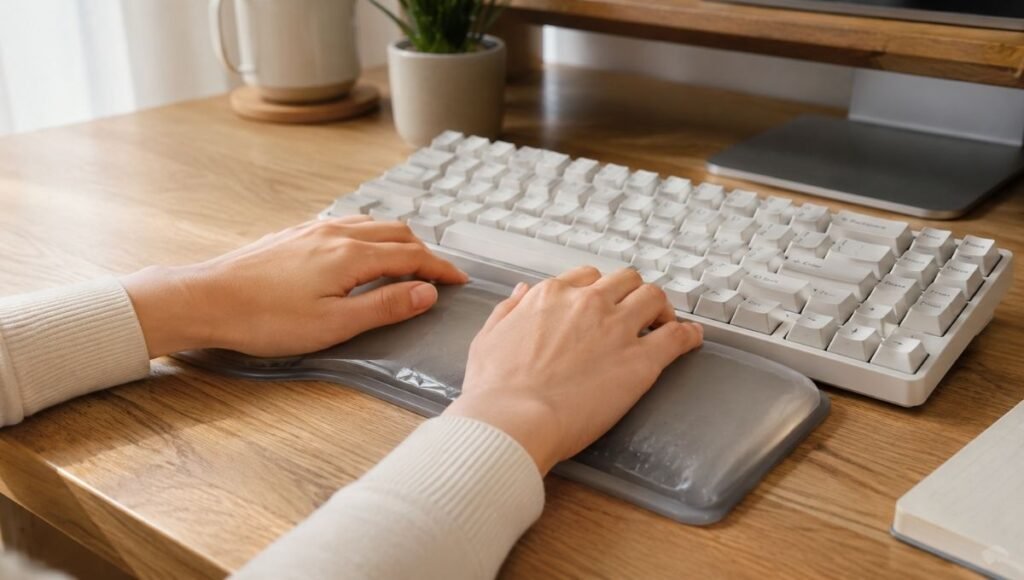
There’s a specific kind of wrist discomfort that builds up quietly.
It’s not sharp pain — nothing that would make you stop typing. It’s a low-grade tightness, a slight ache that’s there when you flex your wrist at the end of the day, a feeling that dissipates overnight and returns by mid-afternoon the next day. You’ve been half-ignoring it for weeks, maybe months, and at some point you search “keyboard wrist rest” and start reading reviews.
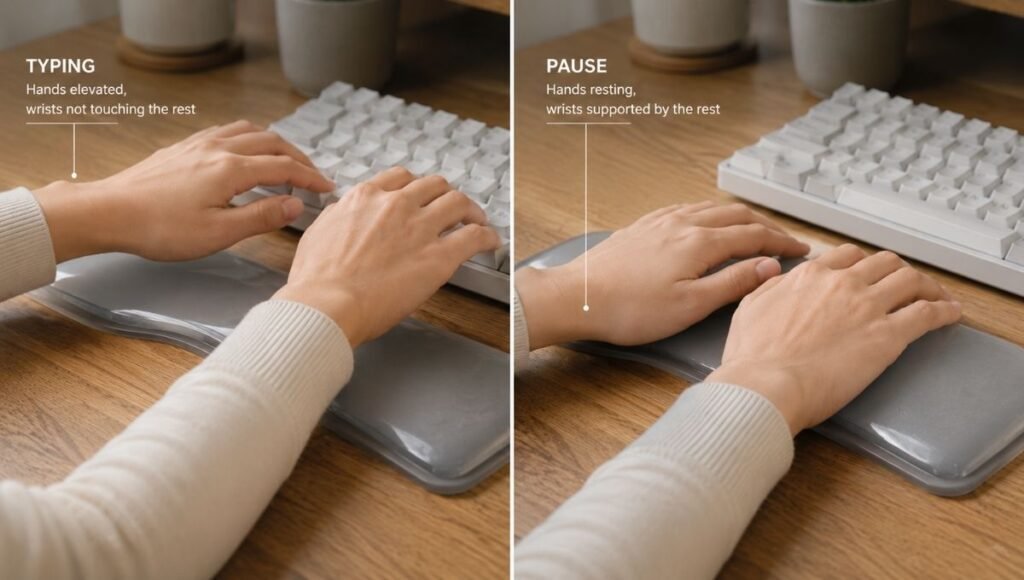
Here’s what most of those guides don’t tell you: a wrist rest used the wrong way — particularly one that’s too thick, too soft, or positioned incorrectly — can actually increase wrist strain rather than reduce it. The classic mistake is resting the wrist on the pad while actively typing, which puts the wrist in extension and adds pressure to the carpal tunnel area. A wrist rest is for pausing, not for typing through.
The good news: once you understand what a wrist rest is actually doing and what it isn’t for, choosing one becomes straightforward. This guide covers the real purpose, the material differences, the keyboard and mouse versions, and the situations where a wrist rest genuinely helps versus where it won’t.
— Daniel Shaw, 7 years working from home, one wrist rest that sat in a drawer for six months before I learned how to use it correctly
Key Takeaways
- A wrist rest is designed for resting during pauses in typing — not for supporting the wrist while actively typing. Using it during active typing can increase wrist extension and strain
- Research published by the National Institute for Occupational Safety and Health (NIOSH) found that wrist rest use reduced hand and forearm muscle fatigue during pauses, but that continuous contact during typing was not associated with reduced load
- The two most common wrist rest materials — gel and memory foam — serve different use cases: gel dissipates heat better and stays cooler; memory foam conforms more but can compress over time
- Keyboard and mouse wrist rests solve different problems and are not interchangeable — the dimensions, height, and firmness requirements differ
- If wrist discomfort persists after three to four weeks of correct wrist rest use combined with proper keyboard positioning, a physiotherapist evaluation is warranted rather than continued equipment adjustment
Wrist Support for Typing: What a Wrist Rest Is Actually Doing
The confusion about wrist rests starts with a naming problem. “Wrist rest” implies something you rest your wrist on while working. The ergonomic reality is more specific: it’s a surface for your palms or wrists to contact during breaks from active keyboard use — while you’re reading, thinking, or pausing between bursts of typing.
During these pauses, your hands drop slightly and the wrist rest prevents them from having to hover above the keyboard, which would require constant low-level muscle activation. The rest allows that activation to stop, which is where the benefit comes from.
During active typing, the correct position is hands slightly elevated above the keyboard, wrists neutral or slightly extended downward, with the wrists not contacting any surface. This is counterintuitive given the product name, but it’s consistent across ergonomic guidelines from OSHA, NIOSH, and Cornell’s Human Factors and Ergonomics research group.
The practical takeaway: a wrist rest that’s too thick pushes the wrist into extension during pauses, which doesn’t help. A rest that’s too soft bottoms out and provides no real support. A rest that’s too tall relative to the keyboard puts the wrist at a bad angle even during pauses. Height matching — the rest should be roughly level with the keyboard home row — is the most important specification to get right.
Wrist Rest for Keyboard: Choosing the Right Type
The keyboard wrist rest sits in front of the keyboard and provides a surface for the wrists and lower palms during pauses. The key variables:
Gel Wrist Rest
Gel rests are filled with a visco-elastic gel that distributes pressure well and stays noticeably cooler than foam alternatives. For home office use where you might work barehand or in a warm room, the temperature difference is real and appreciated over a long session.
Gel rests tend to hold their shape better than foam under sustained use, and they’re typically easier to wipe clean. The surface is usually a fabric or smooth cover over the gel fill.
The practical limitation: some gel rests are too soft, allowing the wrist to sink fully through to the desk surface underneath — which defeats the purpose. Press on the rest with your knuckle before buying (or check reviews specifically for firmness). The gel should provide support, not simply deform around your wrist.
Memory Foam Wrist Rest
Memory foam conforms to the shape of your wrist and palm more precisely than gel, which some people find more comfortable. The foam compresses slowly under pressure and returns to shape slowly, providing a custom fit for the specific pressure pattern your wrist creates.
The concern with memory foam over time: it compresses permanently with sustained use. A new memory foam rest feels supportive; a rest used daily for six months may have developed a permanent depression that no longer provides the right height. This is more of an issue with lower-density foam than high-density versions — check the foam density specification before buying.
Wrist Pad
A wrist pad is typically a thinner, flatter version of a wrist rest — more of a cushioned surface than a raised support. These work better for setups where the keyboard sits at a natural level relative to the elbows and only minimal additional cushioning is needed, rather than a full height correction. For setups where the keyboard is significantly above or below the ideal position, a wrist pad is usually insufficient.
Wrist Rest for Mouse: Different Problem, Different Solution
Mouse wrist discomfort and keyboard wrist discomfort come from different mechanics and need different solutions.
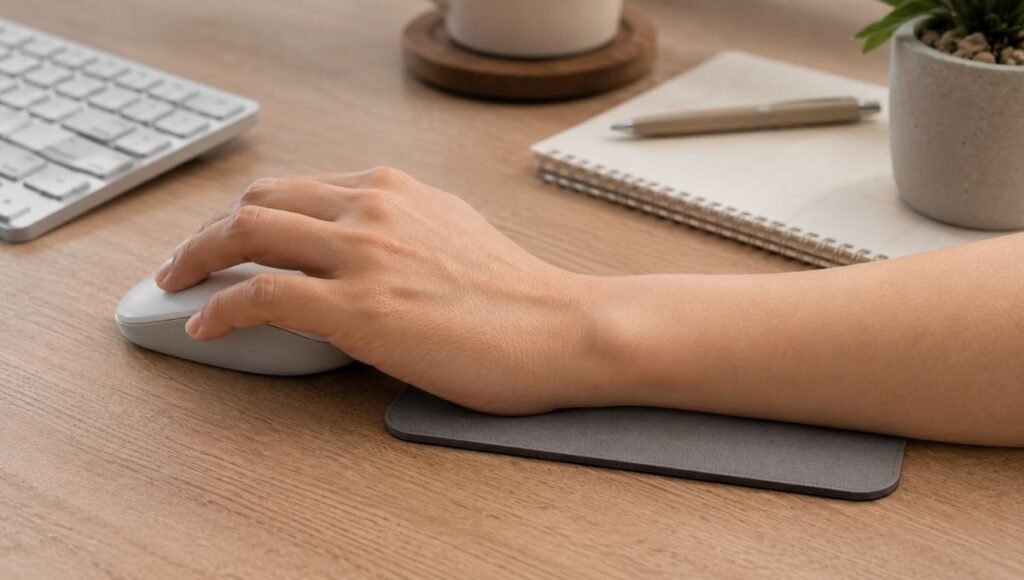
Keyboard use involves repetitive small movements with both hands in roughly fixed positions. Mouse use involves sustained arm movement with one hand in a position that varies depending on how much you’re clicking versus moving. The mouse wrist rest addresses a specific problem: the wrist pressing against the desk surface during mouse use, which creates pressure on the carpal tunnel and ulnar nerve.
A mouse wrist rest is smaller than a keyboard rest — typically a small pad positioned beside the mouse that the wrist contacts when stationary. It should be just high enough to take the wrist off the hard desk surface without raising it to a level that puts the wrist in extension during mouse movement.
The most common mistake with mouse wrist rests: buying a version that’s too thick. A thick mouse wrist rest forces the wrist into upward extension during movement, which is worse than no rest at all. The mouse rest should be thin — roughly equivalent to the height of the mouse’s own body — so the wrist stays neutral when the hand is resting on the mouse.
The ergonomic alternative that some people prefer: a mouse with a contoured form factor that supports the hand without requiring a separate wrist rest, combined with a mouse pad that provides some cushioning at the edges. This eliminates the separate rest and reduces the clutter.
Ergonomic Wrist Rest: What to Look for Before Buying
Four specifications that determine whether a wrist rest will actually help:
Height relative to keyboard home row. The rest should bring your wrist to approximately the height of the keyboard’s home row keys when your hands are relaxed on the rest. Too low and it doesn’t support; too high and it puts the wrist in extension. Measure your keyboard’s height from desk surface to the home row keys — this is your target rest height.
Length. The keyboard wrist rest should be at least as wide as your keyboard, ideally matching it closely. A rest that’s narrower than the keyboard leaves one hand unsupported during pauses. A rest wider than the keyboard wastes desk space without adding benefit.
Firmness. The rest should support your wrist without compressing fully under its weight. Press your wrist onto the rest — it should compress slightly and then hold. If your wrist sinks to the desk level, the rest is too soft.
Non-slip base. A rest that slides when you move from typing to resting position is more annoying than no rest at all. Check that the base has adequate grip for your desk surface material.
When a Wrist Rest Won’t Help
A wrist rest addresses one specific problem: wrist fatigue and minor discomfort from lack of support during typing pauses. It won’t help with:
- Keyboard positioned at the wrong height. If your keyboard is too high, the wrist rest can’t compensate — the whole keyboard needs to come down, either through chair height adjustment or a keyboard tray. → Keyboard Tray Guide — when one is worth it and which type works.
- Active RSI or carpal tunnel syndrome. These conditions require professional assessment and treatment. A wrist rest may be part of a management plan, but it’s not a substitute for diagnosis and treatment.
- Wrist extension from typing technique. If your wrists bend upward significantly while typing — a common habit — the wrist position itself is the problem. A rest won’t correct technique; it will just provide a cushion in the wrong position.
- Shoulder or forearm fatigue from arm position. If the fatigue is higher up in the arm, it’s usually a desk height or monitor position issue rather than a wrist support issue.
When to Seek Professional Help
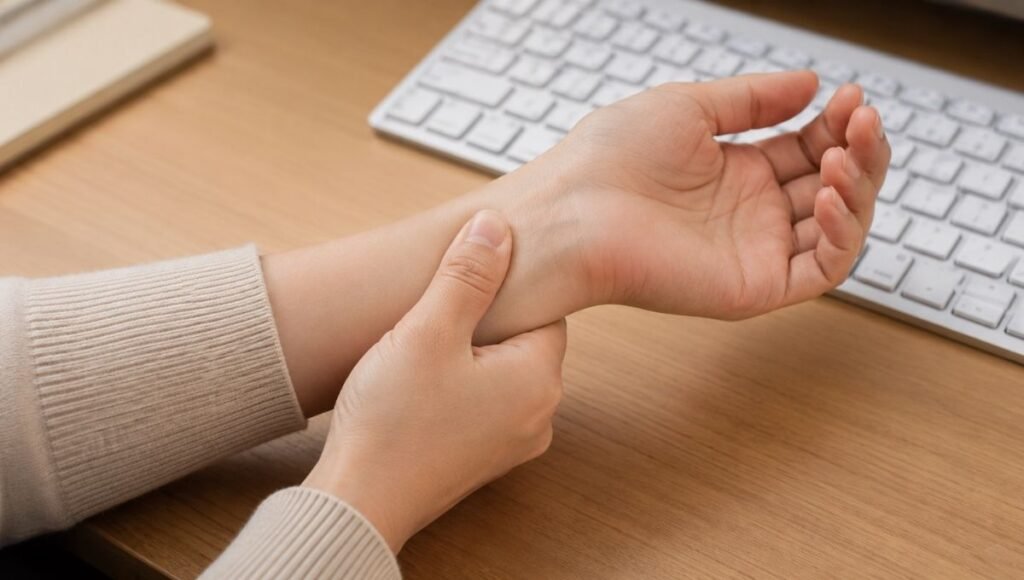
Wrist discomfort from typing is common and often responds to setup adjustments and proper wrist rest use within two to four weeks. The signals that warrant professional evaluation rather than continued equipment adjustment:
- Numbness, tingling, or weakness in the fingers — particularly the thumb, index, and middle fingers (carpal tunnel nerve distribution)
- Wrist pain that persists into the morning rather than clearing overnight with rest
- Pain that occurs during activities outside of typing — handling objects, bending the wrist, gripping
- Any acute sharp pain, swelling, or visible joint changes
These symptoms suggest conditions that need clinical assessment — carpal tunnel syndrome, tendinopathy, or other repetitive strain injuries that a wrist rest cannot address and may aggravate if it changes the wrist position incorrectly.
If You Only Have 10 Minutes Right Now
Before buying anything: check your keyboard position. Sit at your desk with your chair at the correct height for the desk. Are your forearms roughly parallel to the floor? Are your wrists in a neutral, slightly downward position when your hands are on the keyboard?
If your wrists are bending upward significantly to reach the keys — a common issue when chairs are too low or keyboards too high — a wrist rest won’t fix this. The keyboard needs to come down relative to your elbows.
If your wrist position is already good and the discomfort is specifically during typing pauses (hands resting between bursts of work), a gel wrist rest at the correct height for your keyboard is the appropriate tool. Height-match it to the keyboard home row, confirm it’s firm enough not to bottom out, and give it two weeks of consistent use before evaluating.
Frequently Asked Questions
Do I need a wrist rest for my keyboard?
You need a wrist rest if your wrists have no support during pauses in typing and you’re experiencing fatigue or low-grade discomfort after long sessions. If your keyboard is at the correct height relative to your elbows and your typing technique keeps your wrists neutral during active typing, a wrist rest provides a surface to rest on during pauses rather than hovering or dropping to the desk. If your keyboard position is incorrect, a wrist rest won’t help — the keyboard position itself needs to be fixed first.
What is the best wrist rest for keyboard use?
The best keyboard wrist rest is one that matches your keyboard’s home row height, is firm enough to support your wrists without compressing fully, and is as wide as your keyboard. Gel rests stay cooler and maintain shape better than foam over time. Memory foam rests conform more precisely but compress permanently with sustained use. Both work well when properly sized — the height match is more important than the material choice.
Should I use a wrist rest while typing or only during breaks?
During pauses, not during active typing. During active typing, wrists should be neutral and slightly elevated, not resting on any surface. Using a wrist rest as a continuous support during typing puts the wrist into extension — bending upward — which increases rather than reduces carpal tunnel pressure. The rest is for the brief pauses between typing bursts when hands naturally drop.
What is the difference between a wrist rest and a wrist support?
A wrist rest is a desk accessory that provides a surface for the wrist and palm during pauses from typing — it’s passive support for relaxation. A wrist support is typically a brace or wrap worn on the wrist that limits movement and provides joint stabilization — it’s active support used for injury management or prevention during activity. For typing discomfort related to setup and fatigue, a wrist rest is the appropriate tool. For diagnosed or suspected RSI or carpal tunnel conditions, wrist supports are part of clinical management and should be used based on professional advice.
Is gel or memory foam better for a wrist rest?
Gel is generally the better long-term choice for daily desk use. Gel maintains its shape over months of use better than memory foam, dissipates heat better (cooler to the touch during long sessions), and is easier to clean. Memory foam provides a more precise conform to individual wrist shape, which some people prefer for the initial feel — but it compresses permanently over time, particularly in the center where sustained pressure is highest. For a rest that will be used daily for 6+ months, gel or high-density memory foam is more durable.
The Right Rest, Used Correctly
A wrist rest is a simple tool that genuinely helps when the problem it addresses is the actual problem you have: wrist fatigue during typing pauses, on a keyboard that’s already at the right height, with reasonable typing technique. In that situation, a gel or memory foam rest matched to your keyboard height makes a noticeable difference within a week or two.
Used incorrectly — resting on it while typing, at the wrong height, or as a substitute for keyboard position correction — it can make things worse or simply do nothing. The two-minute check of keyboard position before buying anything is always the right starting point.
More from WorkDeskLab:
- How to Set Up a Home Office That Actually Works
- Keyboard Tray — Do You Actually Need One and Which Type Works
- Desk Organization Ideas That Actually Stick
- Desk Accessories — What’s Worth Buying and What Isn’t
References: National Institute for Occupational Safety and Health (NIOSH) / CDC — Wrist rest use and musculoskeletal load during keyboard operation: case study findings (stacks.cdc.gov) · Cornell University Human Factors and Ergonomics Research — Keyboard and wrist positioning guidelines for neutral wrist posture (ergo.human.cornell.edu)
WorkDeskLab is reader-supported. If we recommend a product, we may earn a small affiliate commission at no extra cost to you. This never influences what we recommend. See our Affiliate Disclosure for details.