
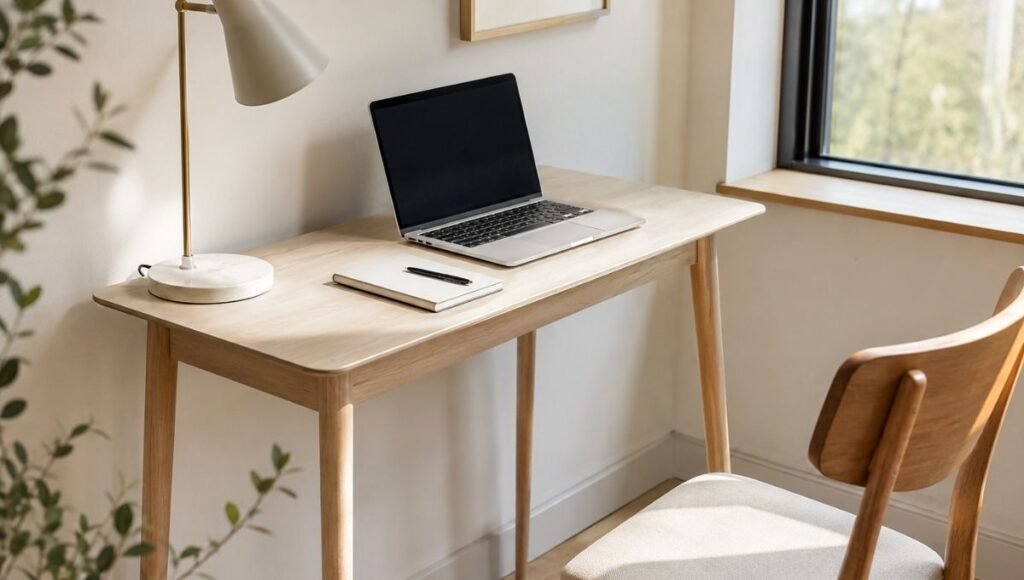
A writing desk sounds like exactly what a home office needs.
It’s clean. It’s simple. It doesn’t try to be everything at once. You find one that looks right — a nice wood surface, maybe a small drawer or two, four legs, exactly the kind of desk that makes a bedroom corner look intentional rather than improvised — and you buy it. Then three months later you’ve run out of surface space, you have no idea where to put the monitor riser, and there are cables going in four directions across a desk that was supposed to be minimal.
Writing desks are genuinely excellent pieces of furniture. They’re also frequently bought by people whose work doesn’t actually suit them. Understanding the difference — what a writing desk actually provides versus what most home office computing work actually requires — takes about five minutes and saves a lot of frustration.
This guide covers what a writing desk is, how it differs from a standard office desk or computer desk, which work types it genuinely suits, and what to look for in size and storage before buying one.
— Daniel Shaw, 7 years working from home, one writing desk that was perfect for one phase of my setup and wrong for another
Key Takeaways
- A writing desk is typically 36–48 inches wide and 20–24 inches deep — smaller and shallower than a standard office desk (48–72 inches wide, 28–32 inches deep)
- Writing desks have minimal storage — usually zero to two shallow drawers — and are not designed for cable management, monitor arms, or heavy equipment
- They suit laptop-only workflows, light writing and reading work, or setups in rooms where a large desk would dominate the space
- For full monitor setups with multiple peripherals and daily computing work of 6+ hours, a writing desk is likely to feel cramped within weeks
- The secretary desk is a writing desk variant with a fold-down surface and enclosed storage — useful for setups that need to disappear when not in use
What Is a Writing Desk? The Actual Definition
A writing desk is a simple, flat-surfaced desk with minimal storage, designed originally for correspondence, handwriting, and reading rather than for equipment-heavy computing work. The defining characteristics are proportions and simplicity: narrower than a standard desk, shallower front-to-back, with one or two shallow drawers at most — or no storage at all.
The historical context is useful here. Writing desks emerged in the 18th and 19th centuries for literal writing — quill pens, inkwells, paper, and correspondence. The dimensions suited that workflow: enough surface for writing paper and a small lamp, a drawer for writing supplies, elegant enough to sit in a study or a bedroom without looking like office furniture. The form has barely changed since. A modern writing desk looks almost identical to a Victorian one, because the underlying purpose hasn’t fundamentally changed.
What has changed is who buys them and why. Today, most people who buy writing desks use laptops rather than paper — which the form accommodates reasonably well. The problem arises when the laptop becomes a laptop-plus-monitor, plus keyboard, plus mouse, plus USB hub, plus a dozen other things that modern home office work accumulates. At that point, a writing desk stops fitting the workflow.
Writing Desk vs Office Desk: The Practical Differences
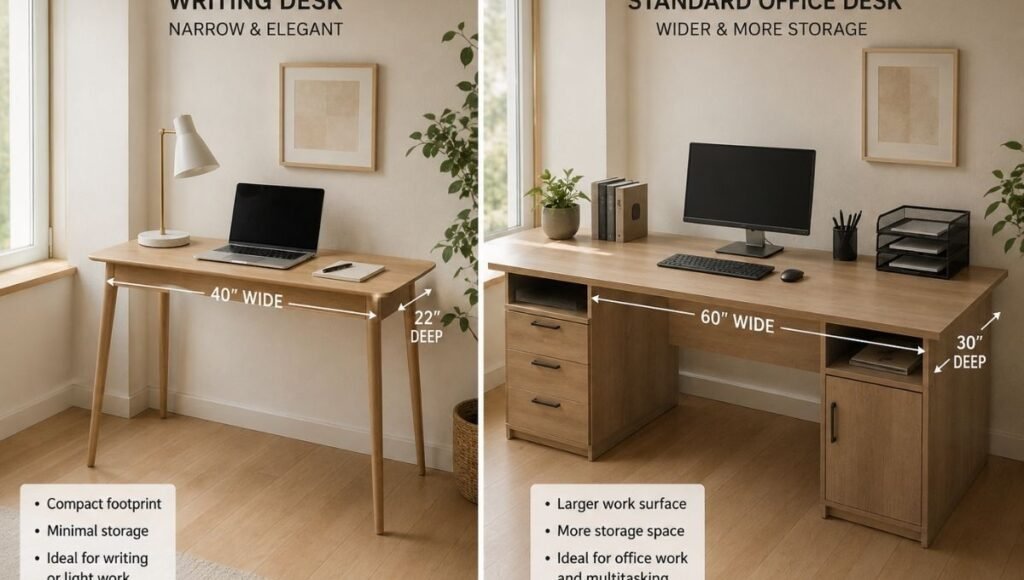
The differences are dimensional and functional, not just aesthetic.
Surface area: A writing desk is typically 36–48 inches wide and 20–24 inches deep. A standard office desk or computer desk runs 48–72 inches wide and 28–32 inches deep. The depth difference is particularly significant — 24 inches of desk depth means a laptop at comfortable viewing distance with very little room for anything else. 30 inches means a monitor at proper viewing distance with room for a keyboard, mouse, and peripheral items beside it.
Storage: Writing desks have zero to two shallow drawers — typically 2–3 inches deep — suited for pens, notebooks, and small supplies. Standard office desks have deeper drawers, sometimes a full pedestal with file-depth drawers on one side. If you have paper files, supplies that need organizing, or equipment that needs a home, a writing desk won’t accommodate it.
Cable management: Writing desks have none. No grommets, no cable channels, no back panels with routing holes. This is a meaningful consideration for any setup with more than a laptop and a charger — cables have nowhere to go except across the surface or down the legs in a tangle.
Weight capacity: Writing desks are built for light use. A heavy monitor, dual-arm mount, or substantial equipment load is at the top end of what most writing desk frames are designed to handle. Standard office desks have heavier frames designed for equipment.
Editor’s note: The depth difference is the one that catches most buyers. 24 inches sounds like plenty. At a desk, with a laptop open to arm’s length and a coffee cup beside it, it fills up surprisingly fast. If you’re considering a writing desk, measure out 24 inches on your current desk surface and see what fits comfortably before ordering.
Small Writing Desk: Who It’s Actually Right For
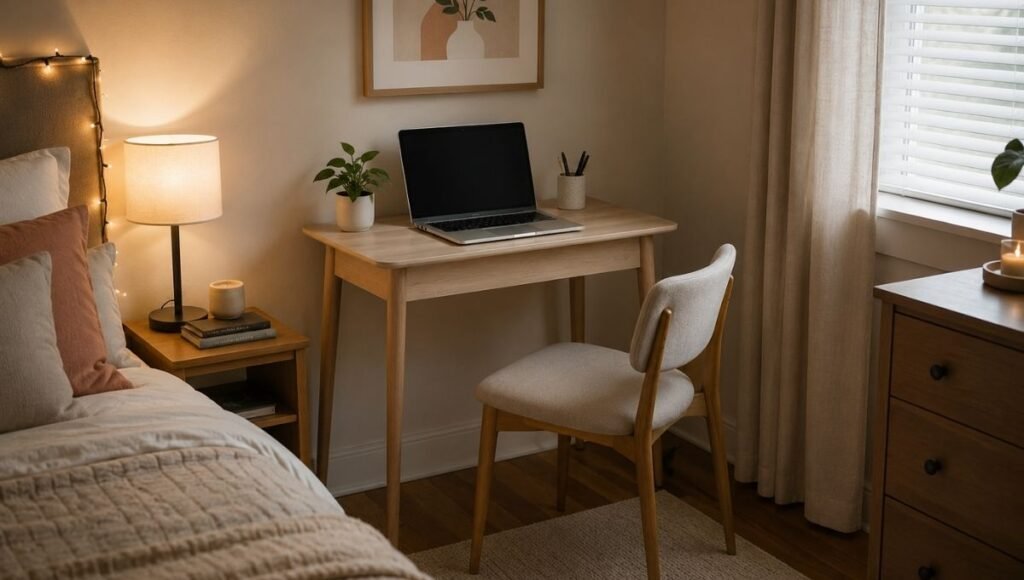
A writing desk is genuinely the right choice for specific setups. The key is being honest about which category you’re actually in.
Laptop-only workers who don’t use an external monitor: If your entire setup is a laptop, a charger, and a notebook — no external screen, no keyboard, no hub — a writing desk provides exactly the right surface area. The laptop fits at viewing distance, there’s space for a notebook beside it, and the desk doesn’t dominate the room the way a larger desk would.
Part-time home workers or students with light workloads: If the desk is used for a few hours per day rather than a full working day, and the work is primarily reading, writing, or light computing, a writing desk serves the purpose without the bulk of a full office desk.
Rooms where a full desk would be inappropriate: A bedroom, a guest room that occasionally doubles as a workspace, a formal study or living room — spaces where a large utilitarian desk would look out of place. A writing desk integrates into these spaces aesthetically in a way that a standard office desk doesn’t.
People who genuinely prefer minimal setups: If you actively want the constraint of a smaller surface — if you work better with less on the desk — a writing desk enforces that discipline. The minimal surface becomes a feature rather than a limitation.
The honest signal that a writing desk is not right for you: if you regularly find yourself wishing you had more surface space on your current desk, or if your setup includes a monitor, an external keyboard, and multiple peripherals, a writing desk will feel cramped within weeks.
Writing Desk with Drawers: Storage Options and What They Actually Hold
Most writing desks with drawers have one or two shallow drawers — typically centered under the desk surface or on one side. These drawers are designed for writing supplies: pens, pencils, a small notebook, sticky notes, a ruler. They’re not designed for file folders, larger notebooks, tech accessories, or the accumulated supplies of a full-time work setup.
The drawer depth on most writing desks is 2–3 inches. A standard file folder is 9 inches tall when upright. A power adapter for a laptop is 1–2 inches thick. Shallow drawers accommodate small flat items comfortably and struggle with almost everything else.
If storage is a priority and a writing desk is the right aesthetic choice, the practical workaround is vertical: a hutch or shelf above the writing desk provides significant additional storage without changing the desk’s footprint. This is a common and effective solution — the desk stays slim, the shelf handles what the drawers can’t. → Desk Hutch and Shelf Guide — how to add storage above any desk.
Secretary Desk: The Writing Desk That Hides
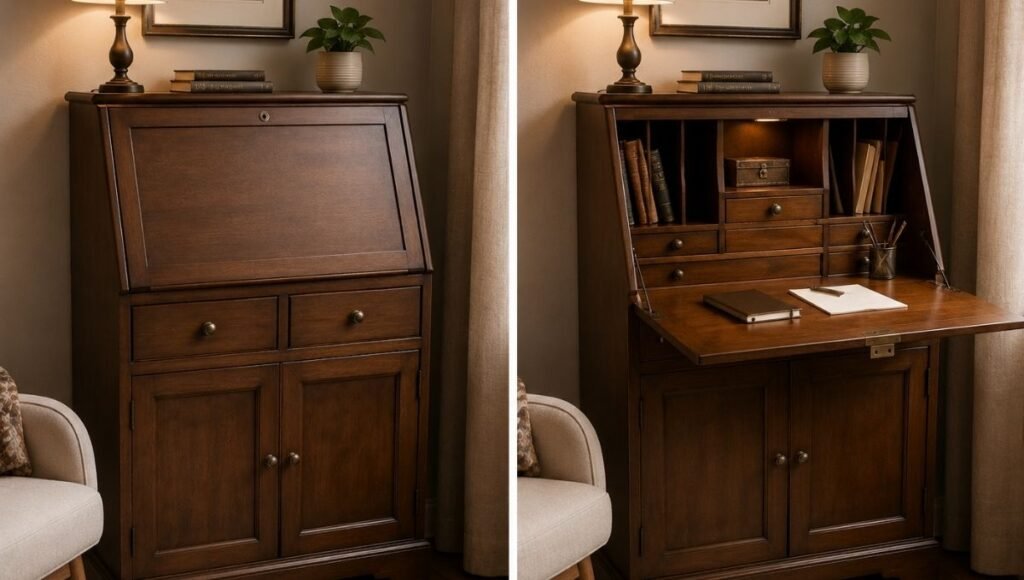
The secretary desk is a specific variant of the writing desk that deserves mention as a separate category. It has a hinged writing surface that folds up to close — hiding the desk surface, any papers left out, and the supply compartments inside — creating what looks like a tall cabinet or bureau when closed.
When open, the folding surface provides a writing desk workspace. When closed, the room shows no desk at all — just a piece of furniture. This makes the secretary desk one of the most effective solutions for setups that need to fully disappear: a bedroom where you don’t want to see “office” during non-work hours, a living room where the desk needs to be invisible to guests.
The practical limitation: secretary desks provide a relatively small working surface (the fold-down panel), and the hinge mechanism means the surface has a maximum weight it can support. For computing work beyond a laptop, most secretary desks are undersized. For light writing and laptop use in a room that needs to maintain a non-office appearance, they’re one of the most elegant solutions available. → For other space-saving desk options: Floating Desk and Fold-Down Desk Guide.
Writing Table: A Simpler Version
A writing table is the most stripped-down version of the writing desk — a flat surface on four legs with no drawers whatsoever. No storage, no frame details, just a work surface. The form appears in minimalist interiors and in Scandinavian furniture design as a deliberate commitment to simplicity.
The practical trade-offs of a writing table are exactly what you’d expect: maximum surface clarity (nothing to accumulate in drawers, nothing to open and close), zero storage, and an aesthetic that reads as intentionally minimal rather than incomplete. For people who work with everything stored elsewhere and bring only what they need to the desk for each session, a writing table is the purest expression of the clean desk principle.
Modern Writing Desk and Wood Writing Desk: Material Considerations
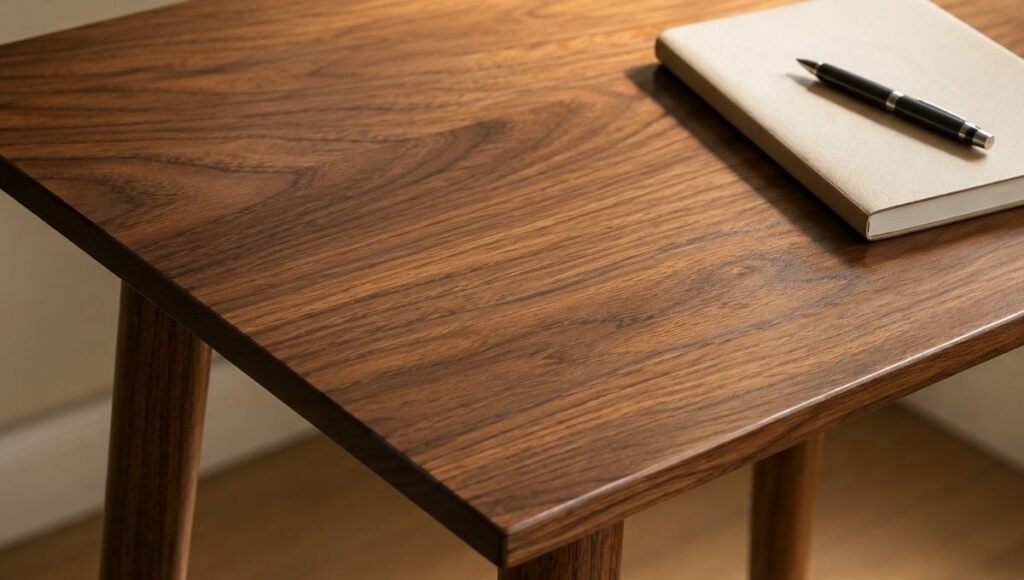
Writing desks come in a wider range of materials and aesthetics than standard office desks, partly because their historical association with formal rooms means they’ve always been designed with appearance in mind.
Wood writing desks (solid wood, wood veneer, or bamboo) are the most common and most durable. Solid wood desks last significantly longer than MDF or particleboard alternatives and hold up to daily use without the surface degradation that cheaper materials show over time. The weight also helps — a heavier desk is more stable for the writing and typing forces applied during use.
Modern writing desks with metal legs and minimal tops work well in contemporary interiors where the desk needs to read as furniture rather than office equipment. The visual lightness of this style — particularly with thin metal legs — makes a small room feel less crowded than a heavier desk would.
The material consideration that matters most for daily use: the desk surface. A surface that scratches easily, shows fingerprints, or deteriorates under regular contact will look worn within a year. Look for surfaces with a durable finish (lacquered wood, powder-coated metal, or solid hardwood) rather than thin veneer over particleboard.
Writing Desk for Bedroom: Making It Work in a Shared Space
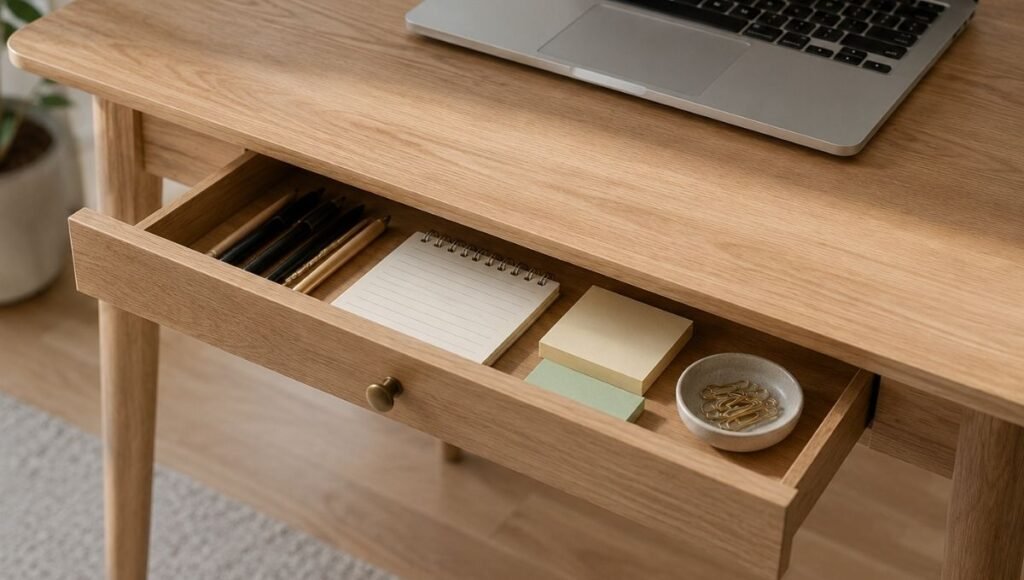
A writing desk is often chosen for bedroom setups precisely because it doesn’t look like a desk in the way that a large office desk does. The smaller footprint and more furniture-like aesthetic integrates into a bedroom without declaring “this room is also an office.”
For bedroom setups, a few considerations become more important than they would in a dedicated office:
- Position relative to the bed: Ideally, the desk faces a wall rather than the bed. Working with the bed in your visual field (and the psychological associations of sleep and rest it carries) makes psychological separation between work and rest harder to maintain.
- Lighting: A bedroom’s overhead lighting is usually warm and low — fine for evening relaxation, insufficient for focused work. A desk lamp with a daylight spectrum bulb on the writing desk makes the workspace feel distinct from the surrounding room and provides the light quality that supports focus.
- Cable discipline: In a bedroom, cables visible on a desk surface are more visually disruptive than in a dedicated office. A writing desk with minimal cable management means more deliberate routing is needed to keep the surface clean. → Desk Setup Guide — cable management as part of the full setup.
What to Check Before Buying a Writing Desk
Four measurements and considerations that determine whether a writing desk will work for your specific situation:
Depth against your equipment. Measure the depth you need: laptop open to comfortable viewing distance, or monitor at arm’s length with keyboard in front of it. If that measurement exceeds 22–24 inches, a standard writing desk won’t fit your setup comfortably.
Width against your work style. A 36-inch writing desk gives you roughly the width of a laptop plus a notebook beside it. A 48-inch desk gives you more flexibility. If you regularly spread documents, have reference materials out, or use a mouse beside the keyboard, the wider end of the range is worth the additional cost.
Height. Standard writing desk height is 28–30 inches — the same as a standard office desk. This suits most people at a standard office chair height. Some writing desks are sold at lower heights (for children or specific uses); confirm the height is appropriate for adult seated work before ordering.
Surface durability. Writing desks appear in a wide range of price points, and surface quality varies significantly. A desk used daily will show wear on the surface — scratches, finish degradation, edge damage — more quickly on cheap laminate than on solid wood or quality veneer. For a desk that will be used every day, the surface finish is worth paying attention to beyond just the aesthetic.
Frequently Asked Questions
What is a writing desk?
A writing desk is a simple, flat-surfaced desk with minimal storage — typically zero to two shallow drawers — originally designed for handwriting, correspondence, and reading rather than computing work. They’re narrower and shallower than standard office desks (typically 36–48 inches wide and 20–24 inches deep), and they prioritize clean aesthetics over cable management, equipment accommodation, or extensive storage. Today they’re commonly used for laptop work, light home office setups, or in rooms where a large utilitarian desk would be aesthetically inappropriate.
What is the difference between a writing desk and an office desk?
The key differences are size, storage, and intended use. A writing desk is smaller (36–48 inches wide, 20–24 inches deep) with minimal storage and no cable management. A standard office desk is larger (48–72 inches wide, 28–32 inches deep) with more storage options and often includes cable management features. A writing desk suits light laptop work and aesthetically sensitive rooms; a standard office desk suits full computing setups with monitors, multiple peripherals, and all-day use.
Is a writing desk good for working from home?
It depends on the work. For laptop-only work, light reading and writing tasks, or part-time home office use, a writing desk is adequate and often preferable — it’s smaller, looks better in non-office rooms, and enforces a minimal surface discipline. For full-time home office work with a monitor setup, multiple peripherals, and 6+ hours of daily use, most writing desks are too small and lack the storage and cable management that full-time work requires.
What is a secretary desk?
A secretary desk is a writing desk variant with a hinged surface that folds up to close, hiding the writing area and creating the appearance of a cabinet or bureau when not in use. When open, it provides a writing desk surface with small storage compartments inside. Secretary desks are particularly useful in rooms where the desk needs to disappear when not in use — bedrooms, guest rooms, or living spaces where an always-visible desk would be intrusive.
What size writing desk do I need?
Measure the depth you need first: place your laptop at a comfortable viewing distance (about arm’s length) or measure how far back your monitor sits when positioned correctly. If that distance exceeds 22 inches, add space for a keyboard in front of it. Most writing desk setups work comfortably at 24 inches of depth for laptop-only use. Width depends on whether you need space for materials beside the primary work item — 36 inches is minimal, 48 inches provides comfortable working width for most setups.
Match the Desk to the Work
A writing desk is a considered, deliberate choice — not a default. It works exceptionally well for specific workflows and specific rooms, and it falls short for others in very predictable ways.
Laptop-only, light work, rooms where a large desk would look wrong: a writing desk is exactly right. Full computing setup, all-day work, multiple peripherals: a writing desk will frustrate you within weeks. The measurement test — laying out your actual equipment dimensions before ordering — takes five minutes and makes the decision straightforward.
More from WorkDeskLab:
- How to Set Up a Home Office That Actually Works
- Home Office Layout — positioning your desk correctly in any room
- Desk Hutch and Shelf — adding storage above a writing desk
- Floating Desk and Fold-Down Desk — other space-saving options
- Desk Organization Ideas — keeping any desk organized long-term
- Desk Setup Guide — the complete ergonomic workstation
References: U.S. General Services Administration — Federal Workplace Standards: Workstation dimensions and surface area requirements for office environments (gsa.gov) · Cornell University Human Factors and Ergonomics Research — Desk depth, monitor distance, and posture in home office configurations (ergo.human.cornell.edu)
WorkDeskLab is reader-supported. If we recommend a product, we may earn a small affiliate commission at no extra cost to you. This never influences what we recommend. See our Affiliate Disclosure for details.