
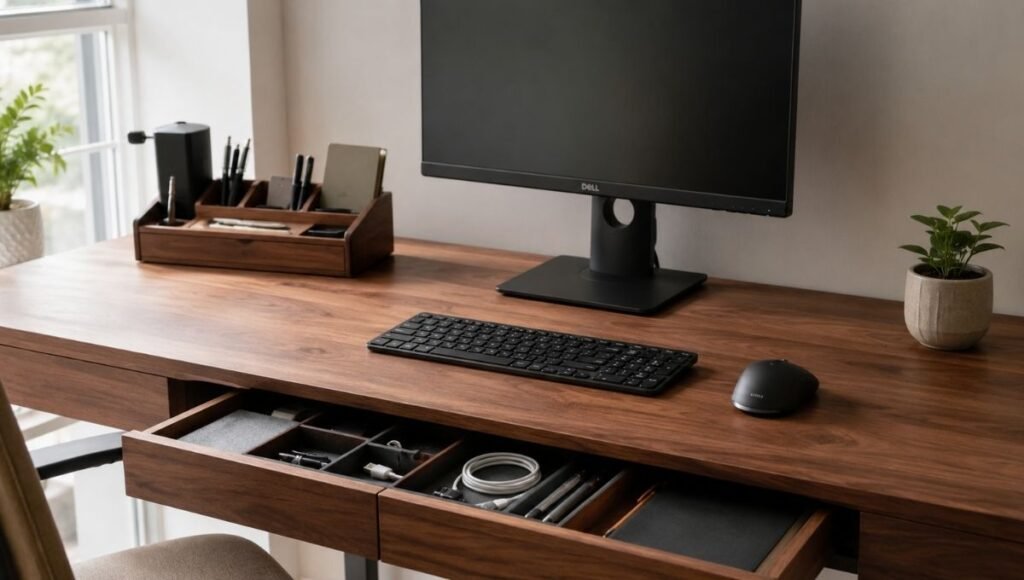
Most people who buy a desk organizer already have a desk organizer.
It’s in the drawer, or on a shelf, or at the back of the desk behind other things. They bought it six months ago when the desk got bad enough to feel like a problem. They spent an afternoon organizing. It looked good for about a week. Then the desk returned to its natural state — which is to say, cluttered — and the organizer became part of the clutter.
This is the pattern that most desk organization guides don’t address. They give you a list of products to buy, some tips about zones and categories, and a photo of a desk that’s been staged for a photoshoot. What they don’t tell you is why the system collapses after two weeks, or what actually determines whether an organization system holds up over months rather than days.
The answer isn’t a better organizer. It’s a system that matches how you actually use the desk — not how you think you should use it, and not how it looks in inspiration photos. This guide covers how to build that system, what to buy (and when), and the deeper reasons why previous attempts haven’t worked.
— Daniel Shaw, 7 years working from home, multiple failed desk organization attempts before figuring out what actually determines whether a system holds
Key Takeaways
- A desk organization system collapses when items don’t have a specific, easy-to-return-to home — the solution is defined spots, not more storage
- Research from Princeton University’s Neuroscience Institute found that visual clutter reduces the brain’s ability to focus and process information — desk organization has measurable cognitive benefits beyond aesthetics
- The correct sequence: remove everything first, identify what actually gets used daily, then build storage around those specific items — not the other way around
- Desk drawer organizers are the highest-ROI purchase for most desks — they convert a single drawer into organized storage for 15–20 small items without taking any surface space
- A system that requires effort to maintain will fail within two weeks — sustainability comes from making the organized state easier than the disorganized one
Why Desk Organization Systems Fail (The Real Reason)
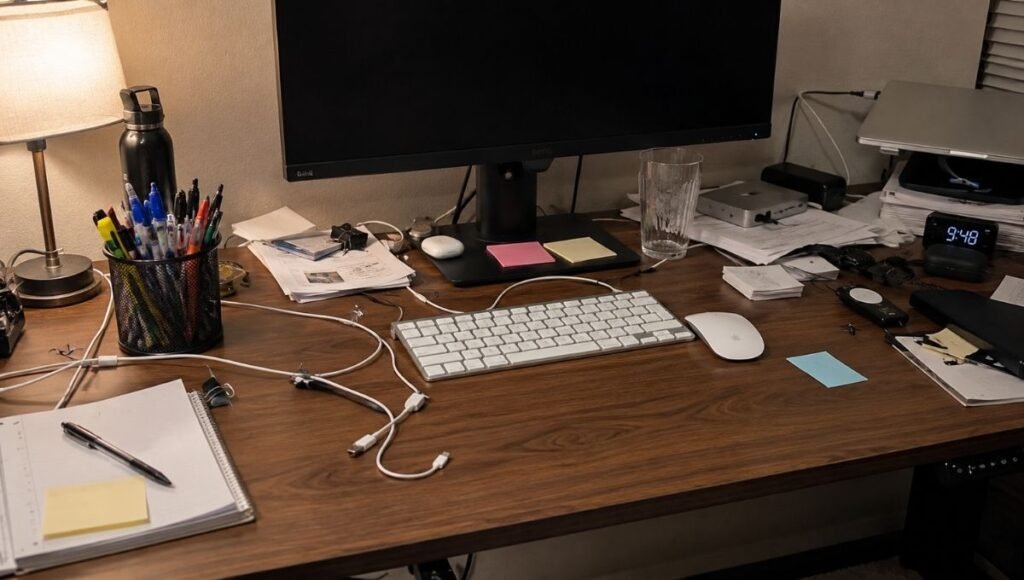
The failure isn’t motivation, and it isn’t the wrong products. It’s that most organization systems are built around an idealized version of how the desk should be used rather than an honest assessment of how it actually gets used.
The clearest example: the pen cup. Almost every desk organization guide recommends a pen cup or pen holder. Most desks already have one. The pens that get used daily are never in it — they’re on the desk surface, in a pocket, or wherever they landed last. The pen cup holds the pens that never get used: the dried-out ones, the promotional ones, the ones that were already there when the cup arrived.
The pen cup didn’t fail because it’s a bad product. It failed because it was placed on the desk before anyone asked which pens actually get used daily and where they need to be to get used.
This is the pattern. Organization products get bought for a hypothetical desk user who is more organized, more consistent, and more deliberate than the actual person who sits there every day. The actual person reverts to their natural habits within two weeks, and the products become obstacles rather than systems.
The fix is to build the system around the actual habits — starting with an honest audit of what’s on the desk and why it’s there.
How to Organize Your Desk: The Right Starting Point
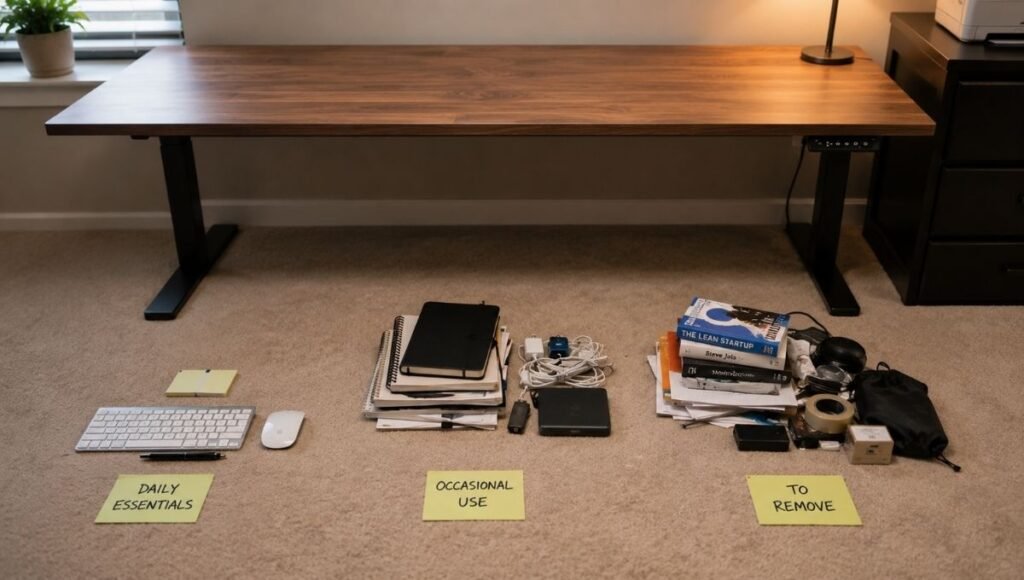
Before buying anything, the audit. This takes thirty minutes and is the most valuable step in the entire process.
Clear the desk surface completely. Put everything on the floor, a table, or any available surface — just get it off the desk. Now look at the empty desk for a moment. This is what you’re trying to get back to. Everything that goes back onto the desk needs to earn its spot.
Now go through the items on the floor and sort them into three groups:
- Daily use: Items you reach for every single working day without thinking. Keyboard, mouse, one or two pens, phone, notebook if you use one. For most people this is 5–8 items.
- Regular use: Items you need several times a week but not every day. Reference materials, specific supplies, secondary tools. These belong in a drawer or nearby shelf, not on the surface.
- Rare or never: Items that ended up on the desk through accumulation rather than deliberate placement. Old receipts, expired medication, cables for devices you don’t own anymore, three staplers. These either get thrown away, stored elsewhere, or acknowledged as clutter that was never serving a purpose.
The daily-use group is the only one that goes back on the desk surface. Everything else gets a home elsewhere. This single decision — keeping the desk surface reserved for daily-use items only — is what determines whether the system holds.
→ For the full desk organization framework: Desk Organization Ideas That Actually Stick.
Desk Drawer Organizer: The Highest-ROI Desk Organization Purchase
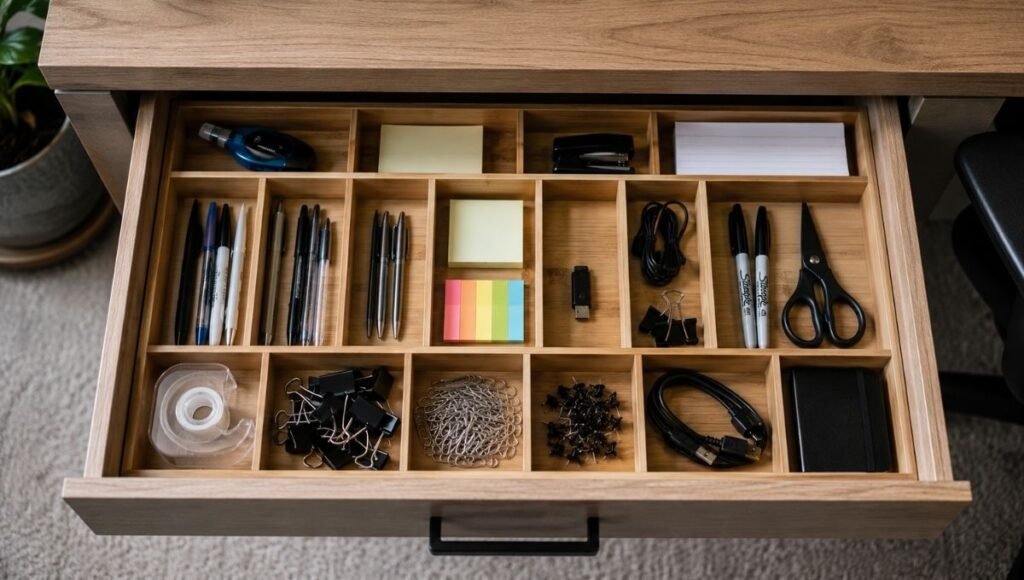
If there’s one desk organization product that consistently delivers the most improvement for the cost, it’s the desk drawer organizer. A single drawer without organization is a black hole — items go in, items don’t come back out, and eventually the drawer becomes unusable except for dumping things you don’t know what to do with.
A drawer organizer converts that space into defined compartments: one for pens and pencils, one for small supplies (paper clips, sticky notes, erasers), one for cables or adapters, one for whatever else gets regular use. The compartments do what the open drawer couldn’t: give each category a specific home, so items go back where they came from rather than wherever there’s space.
What to look for in a desk drawer organizer:
- Adjustable dividers: Fixed-compartment organizers rarely match the actual dimensions of what you’re storing. Adjustable dividers let you configure the space around your specific items rather than adapting your items to the organizer’s fixed layout.
- Depth compatibility: Measure your drawer depth before ordering. Most desk drawers are 2–3 inches deep; some organizers are designed for deeper file drawers. A 4-inch organizer in a 2.5-inch drawer is worse than no organizer.
- Material: Bamboo and wood organizers look better than plastic equivalents and hold up better over years of daily use. They’re worth the small additional cost for a permanent desk setup.
The practical test: after installing a drawer organizer, every item that goes into the drawer should have a specific compartment it belongs in. If something doesn’t have a compartment, either create one or reconsider whether that item belongs in the drawer at all.
Desktop Organizer: When Surface Storage Makes Sense
A desktop organizer — a multi-compartment unit that sits on the desk surface — makes sense in specific situations: when you use enough different items daily that the desk surface becomes crowded without organization, or when you have no drawer storage available and need surface-accessible storage for regularly used items.
The common mistake: buying a desktop organizer as the first step in organizing a cluttered desk. A cluttered desk has too many things on it — adding another object to hold those things doesn’t solve the core problem. The audit comes first. If the audit reveals that 12 daily-use items genuinely need to be on the desk surface, a desktop organizer is the right solution. If the audit reveals that most of what’s on the desk doesn’t belong there at all, the organizer makes the problem worse by making the clutter look organized.
Desktop organizers work best as a complement to drawer organization rather than a substitute for it. The desk surface holds what gets used constantly; the drawer holds what gets used regularly; the desktop organizer holds the medium-frequency items that need to be visible and accessible without being in the primary working area.
Desk Organizer Set
Desk organizer sets — coordinated collections of a pen cup, tray, file holder, and other pieces — are popular because they look cohesive and seem to solve multiple problems at once. They often disappoint for the same reason: they’re designed as matching collections, not as solutions to specific problems you have.
A set typically includes pieces you need and pieces you don’t. The pieces you don’t need still take up desk surface space, making the desk more crowded than it was. Buying individual pieces for specific, identified needs almost always produces better results than buying a set and trying to find a use for all of it.
Declutter Desk: The Process That Makes Organization Possible
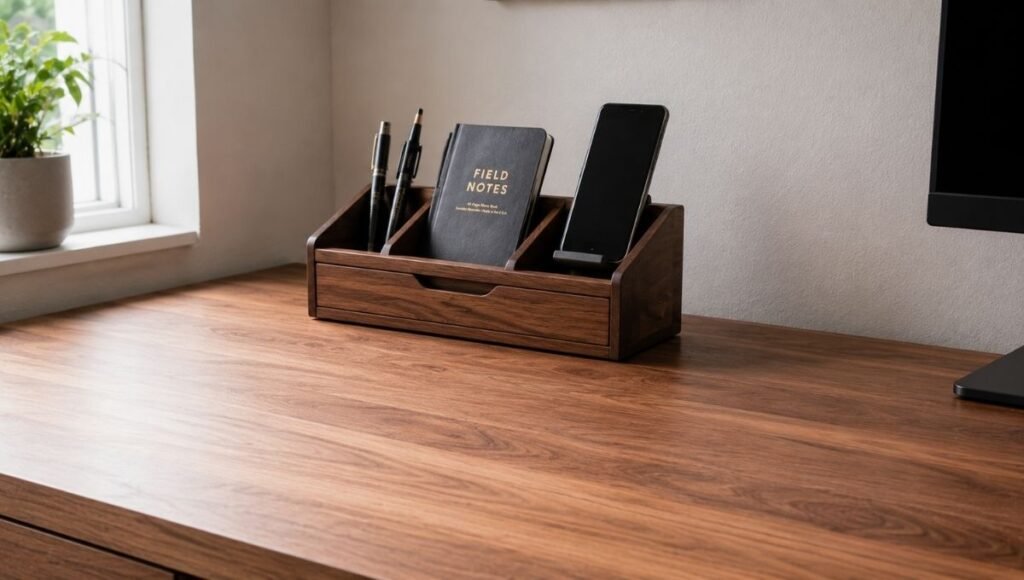
Decluttering and organizing are different steps, and they need to happen in the right order. Organizing before decluttering means creating a neat arrangement of things that shouldn’t be there in the first place. Decluttering first reveals the actual problem to be organized.
The desk clutter audit question for each item: “Would I notice if this disappeared?” If the answer is no — if the item could vanish without affecting your daily work — it doesn’t belong on the desk surface.
Three categories of desk clutter that accumulate differently:
Passive accumulation: Things that arrived on the desk and never left — mail, receipts, items from bags and pockets. The fix is a single designated inbox tray for incoming items, reviewed and cleared daily. Without a designated landing spot, every flat surface becomes one.
Decision avoidance: Things you can’t decide what to do with — the cable for a device you might get rid of, the document you might need someday. These create a specific kind of clutter because they resist the normal rules: you can’t throw them away (maybe you’ll need them) but you don’t actively use them (they stay on the desk without purpose). The fix: a time-limited holding box. Put decision-avoidance items in a box with a date written on it. If you haven’t needed anything in the box in 30 days, discard without reviewing.
Tool migration: Items that belong somewhere else but migrate to the desk because that’s where you were when you used them. Scissors, tape, charging cables, medication. The fix is storage near where these items are actually used, not near the desk — and deliberate return habits rather than surface storage.
Office Desk Organizer: Vertical Space and Hidden Storage
Most desk organization thinking is horizontal — what goes on the surface, what goes in the drawer. The vertical dimension is where significant additional organized storage is available without adding desk footprint.
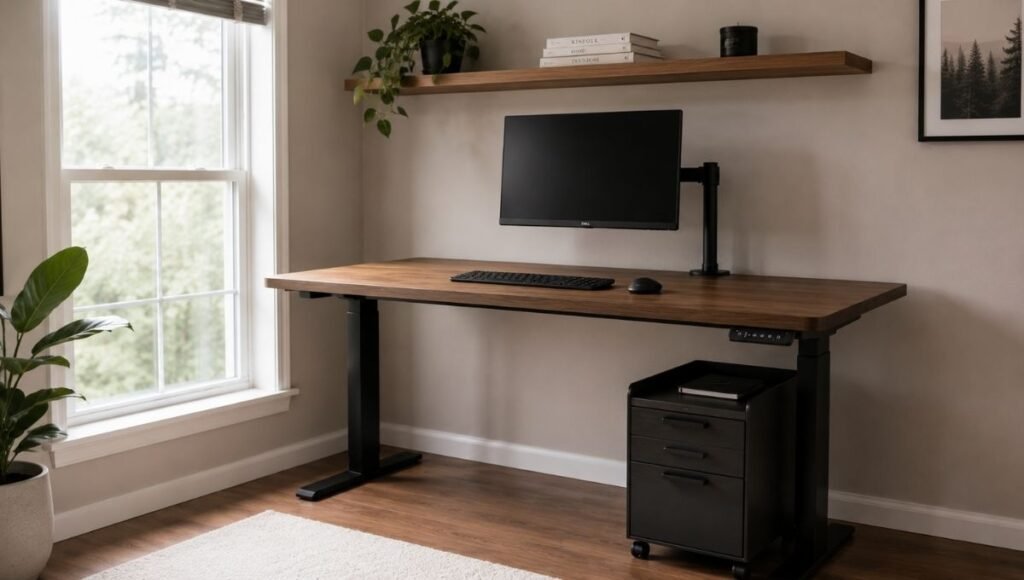
Above the desk: A shelf at the correct clearance height (22–24 inches above the desk surface) provides organized storage for books, reference materials, and supplies without taking any desk space. → Desk Hutch and Shelf Guide — how to add storage above your desk without making it feel smaller.
Under the desk: The space under the desk is almost always underused. Under-desk storage solutions — rolling drawers, hanging organizers, shelf units — convert this space to organized storage for items that need to be accessible but don’t need to be visible. → Under Desk Storage Guide — how to reclaim the space you’re wasting.
Cable management as organization: Cables on the desk surface and floor are a form of clutter that doesn’t respond to conventional organizers — they need their own system. Cable clips route individual cables; a cable tray under the desk holds the power strip and cable bulk off the floor entirely. → Desk Cable Management Guide — how to hide every wire without drilling. → Cable Tray Guide — how to choose, install, and keep it working.
Desk Organization Tips: The System That Holds
Organization systems that hold over months share one characteristic: the organized state is easier to maintain than the disorganized one. When returning an item to its place requires less effort than leaving it somewhere random, the system maintains itself. When it requires more effort, the system fails.
Three principles that determine whether a system holds:
One action to return. Every item should go back to its home in one motion — open a drawer and drop it in, set it in the tray, hang it on the hook. Multi-step returns (open drawer, move other things aside, find the right compartment, place the item) fail because the friction accumulates across dozens of daily interactions.
Empty desk as the default state. A desk that gets cleared at the end of each working session starts the next day organized rather than adding to the previous day’s accumulation. Five minutes to clear the desk surface before finishing is the single habit that sustains an organization system longer than any product purchase.
No homeless items. Every item that belongs on or near the desk needs a specific home. Items without homes accumulate on the desk surface by default — not through laziness but through lack of alternatives. If something keeps ending up on the desk surface and you can’t justify it as a daily-use item, it either needs a home elsewhere or it needs to leave the workspace entirely.
Frequently Asked Questions
What is the best desk organizer?
The best desk organizer is the one that solves the specific problem you’ve identified after auditing your desk. For most home office setups, a drawer organizer with adjustable dividers delivers the most improvement — it converts unusable drawer space into organized storage without taking any desk surface. For desks without drawers, a compact desktop organizer holding daily-use items is the next best option. A desk organizer set is rarely the right answer because it includes pieces for problems you may not have.
How do I keep my desk organized long-term?
Three habits that sustain desk organization over months: clearing the desk surface completely at the end of each working day (5 minutes), ensuring every item has a specific home that’s easy to return it to, and doing a monthly audit to catch items that have accumulated without purpose. The daily clear is the highest-leverage habit — a desk that starts each day clean accumulates clutter more slowly and is easier to reset than one that carries over from the day before.
Why does my desk always get messy again?
Usually one of three reasons: items don’t have specific homes so they default to the desk surface, the system requires more effort to maintain than to ignore, or the desk holds more things than it should. The audit — removing everything and only returning daily-use items — identifies which problem applies. Most cluttered desks have all three to some degree, but the item-without-a-home problem is the most common root cause.
What should I put in a desk drawer organizer?
Organize drawer contents by frequency of use: regularly-used items in the top or most accessible drawer (pens, sticky notes, small tools you reach for several times a week), reference and backup items in secondary drawers (spare cables, backup supplies, documents). Each compartment should hold one category of item — mixing categories defeats the organizational benefit because you still have to search within the compartment to find what you need.
How do I start organizing a messy desk?
Start by removing everything from the desk surface and sorting into three groups: daily use (goes back on the desk), regular use (goes in a drawer or nearby storage), and rare or never (gets removed from the workspace or discarded). Only daily-use items return to the desk surface. Then organize the regular-use items into drawer storage with a drawer organizer. This sequence — audit first, storage second — produces better results than buying organizers and fitting items into them.
Build It Around How You Actually Work
The desk organizer that works isn’t the most aesthetically satisfying one or the most comprehensively equipped one. It’s the one built around an honest understanding of which items you actually use daily, where they need to be to get used, and what makes returning them to their home as effortless as possible.
Start with the audit. Remove everything, identify what actually earns desk surface space, and build the storage system around those specific items. The organizer comes after the system — not before it.
Complete guides for every element of desk organization:
- Desk Organization Ideas — systems that actually stick
- Desk Cable Management — hide every wire without drilling
- Cable Tray — how to choose, install, and keep it working
- Under Desk Storage — how to reclaim the space you’re wasting
- Desk Hutch and Shelf — add storage above your desk
- How to Set Up a Home Office That Actually Works
References: Princeton University Neuroscience Institute — “Interactions of Top-Down and Bottom-Up Mechanisms in Human Visual Cortex,” Journal of Neuroscience, 2011 · Journal of Environmental Psychology — “Physical order produces healthy choices, generosity, and conventionality, whereas disorder produces creativity” (2013)
WorkDeskLab is reader-supported. If we recommend a product, we may earn a small affiliate commission at no extra cost to you. This never influences what we recommend. See our Affiliate Disclosure for details.